Introduction and overview
Ganden Datshang Lhundrup Ling, commonly known as Dhe-Tsang Monastery, is located next to Chunkou Village (春口村) in Datsang (Ch: Dazang) Township, Barkham (Ch: Ma’erkang) County, Ngawa (Aba) Tibetan and Qiang Autonomous Prefecture, Sichuan. A Gelug order monastery, Dhe-Tsang was established by a disciple of lineage founder Tsongkhapa in the early 15th century, when the order was rapidly expanding from its birthplace at Ganden Monastery in central Tibet. Dhe-Tsang is one of the oldest Gelug monasteries and has for many years enjoyed a prominent position on the eastern Tibetan plateau.
Video (1 min 39 sec): Kham Aid Foundation team assessing the condition of Dhe-Tsang Monastery.
The Tibetan name ད་ཚང da tshang (大藏, da zang) means “perfect confidence” or “complete satisfaction.”1 I use the Romanized spelling “Dhe-Tsang” because that is the name by which the monastery is best known to English-speakers overseas.
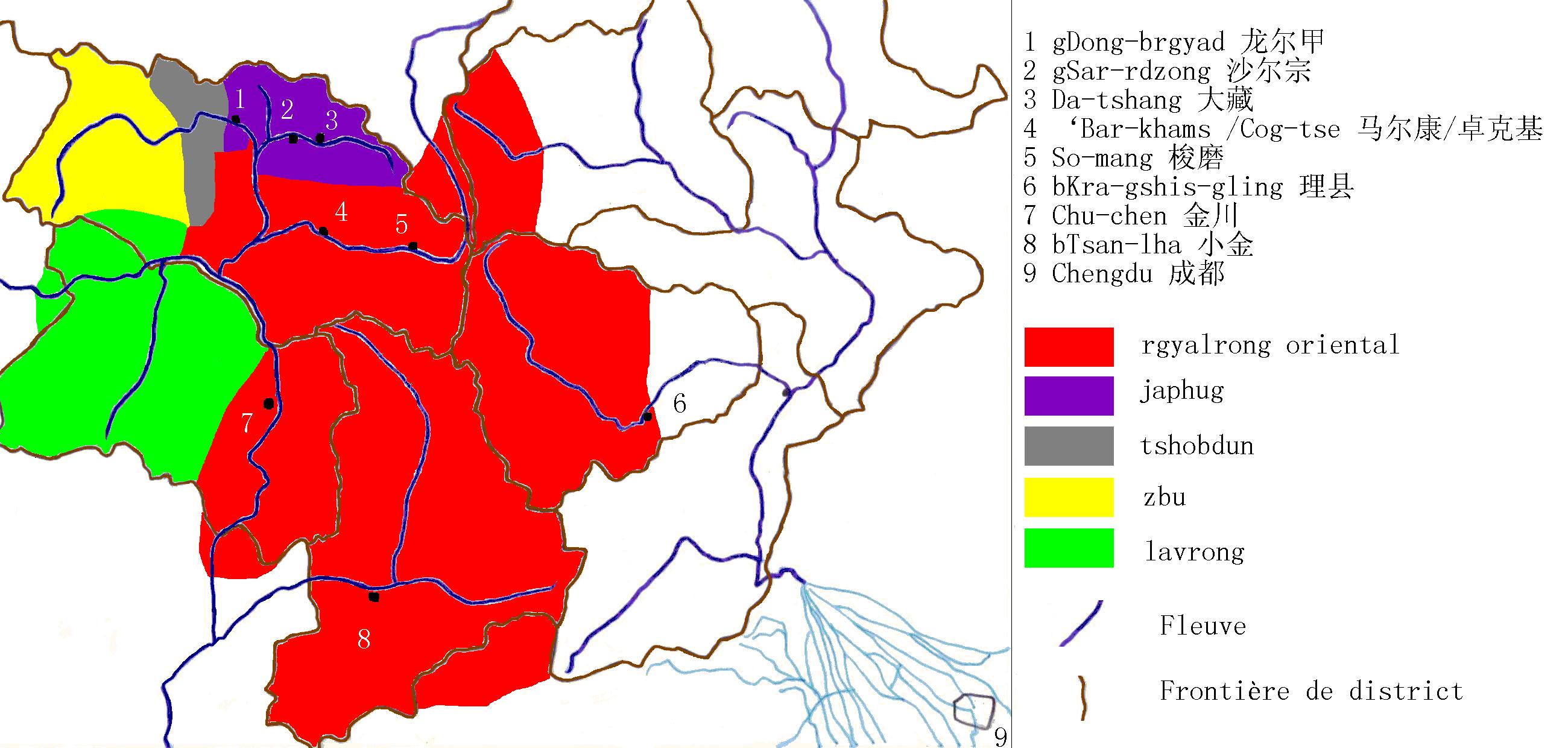
The monastery is set high on a mountainside above the valley of the Chabao River and the steeply terraced farmland that lines it. The site lies within Gyalrong, an ethnic enclave on the eastern Tibetan plateau. Gyalrong is differentiated from neighboring Kham and Amdo areas by its political history, the non-Tibetan languages used there, and the comparative strength of its Bön faith.2

At the time of Kham Aid Foundation’s visits in 2001 and 2002, some sixty buildings populated the site, consisting of the main chanting hall, several smaller temples, numerous houses used as living quarters for monks, and a cookhouse. The Protector Temple is the oldest large structure and has been modified and expanded several times since its original construction. Its interior walls are adorned with about 400 square meters of murals of various ages. The KhamAid team noted a part of the building appears to be older than the rest of the structure and may date from the monastery’s founding.

In 2001-2, the site had approximately 20 three-story monk residences consisting of stone masonry with a timber frame and wooden embellishments. Our field team found seventeen of these residences adorned with murals. Virtually all of Dhe-Tsang’s art was at that time threatened by moisture leaking from roofs, inadequate drainage, mechanical damage, dirt, and defacement, and instability of the structures holding them.
The Sichuan government recognized Dhe-tsang as a provincial-level cultural relic in 2007; six years later it was named a site of national-level significance.3

The 7th Khejok Rinpoche Lobsang Dhundop (1936-2013) was a prominent tulku of Dhe-Tsang during a critical period of its history.4 His autobiography states the Khejok title traces directly back to Ngawang Drakpa, Dhe-Tsang’s founder.5 The 7th Khejok Rinpoche lived at Dhe-Tsang as a teen from 1946 until 1954, when he departed to study at Sera Monastery. His autobiography provides a rich and detailed account of Dhe-Tsang’s monastic life. Another tulku line at Dhe-Tsang is called Jamkhang, which seems to be the same as the “Kankang” mentioned in some Chinese language sources.

Under my leadership as president of Kham Aid Foundation, with project technical direction by Jonathan S. Bell, our aims were to document significant buildings and to stabilize and conserve wall paintings in two of them. Our top priority was the Protector Temple, but we were also interested in a monk’s dwelling called kata that had richly painted walls and a set of wonderful mandalas on the ceiling in an excellent state of preservation.

We completed a preliminary condition assessment in 2001 with special attention to the wall paintings. The following year, we again sent a team to the site to continue , but after a few days, officials from the county Religious Affairs Bureau came to the monastery to stop the work, stating that, although the monastery was within their purview, they lacked authority to allow cultural heritage conservation there. Apart from compiling reports on site condition, the project did not achieve its aim of intervention to arrest the gradual loss of historic art and architecture.
—–
History
15th century: beginnings
The monastery’s founder was Tsakho Ngawang Drakpa (tsha kho ngag dbang grags pa), who was born in 1365 in the Tsanlha chiefdom, also known as Lesser Jinchuan, today’s (Ch) Xiaojin County in Ngawa Prefecture.6 At age sixteen Ngawang Drakpa left his home on the eastern Tibetan plateau and traveled to central Tibet. There he became a disciple of Tsongkhapa, the brilliant and charismatic scholar whose doctrine became the foundation for the Gelug school of Tibetan Buddhism.

After 28 years of study with Master Tsongkhapa, in 1410 Ngawang Drakpa decided to return to his Gyalrong homeland to spread Gelug teachings there. Before he left, Tsongkhapa bestowed a string of 108 prayer beads to him as a parting gift. So inspired was Ngawang Drakpa that he took an oath to establish one hundred and eight monasteries in Gyalrong.7 A year later Ngawang Drakpa was joined by fellow disciple Tsenapa (ltse nag pa). The pair were part of a wave of Gelug influence spreading from the order’s birthplace at Ganden Monastery to the periphery of the Tibetan plateau, displacing Bön and Sakya traditions, which dominated Gyalrong.
The following story is told about how Ngawang Drakpa chose the site to build Dhe-Tsang Monastery. As he was surveying the area searching for a suitable location, a crow snatched his khadak (offering scarf) and flew away with it. Following the crow to a juniper tree8 where the bird had dropped the scarf, he looked at the tree’s base and saw a nest of ants busily working, reminding him of monks. Ngawang Drakpa realized that the tree marked an auspicious location. He trimmed the branches to make a pillar (pictured here), then erected Dhe-Tsang’s main chanting hall around it.
Local Bön masters did not want their power supplanted by this dynamic new faith from the west, and they bitterly opposed construction of the new Gelug temple. By day, Ngawang Drakpa’s workers laid stones for the new monastery, but at night the structures collapsed, and this was blamed on Bönpo black magic. Ngawang Drakpa was casting about for a means to overcome this obstacle when he was again visited by a crow, so he gave the bird a note to carry to Master Tsongkhapa in Lhasa. After a few days, the crow returned with a manual on a spiritual practice called “Solitary Hero Vajrabhairava Empowerment,” which Ngawang Drakpa then deployed to subdue “more than forty local Bön magicians” and overcome Bönpo opposition to the Dhe-Tsang project.9.

The two Gelugpa missionaries battled their Bönpo foes not only in the spiritual realm, but also on the earthly plane, at least according to The Political and Religious History of Amdo, which records that Tsenapa “slew (sha si 杀死) many leaders” of the Bön sect.10. Tsenapa explained why such measures were necessary: “It’s not because of arrogance in my heart, but to spread the Dharma. I go to the Bön sect as an arrow to a target, transferring them to the Dakini realm (of emptiness)!”11
Although enmity between the two sects was far from over, Ngawang Drakpa overcame local opposition to construction of Dhe-Tsang, and in 1414 he established the monastery as the last of the hundred and eight he had vowed before master Tsongkhapa to build. The complex included eight monk residences, the Mahavira Hall, the Protector Temple, and a building where Ngawang Drakpa himself resided, later called the Founder’s House.12

16th to 19th century: forging alliances
Clues to the monastery’s life in subsequent centuries are likely to be found in Ming and Qing dynastic histories (covering 1368-1644 and 1616-1912 AD, respectively), but I have not been able to access those original sources. Secondary sources suggest warm relations between Dhe-Tsang and the Chinese imperial throne during this period. For example, in 1571, the third incarnation of a Dhe-Tsang Monastery tulku, (Ch) Langsoga Yixi, received support from Sonam Gyatso, who was later to be designated as the 3rd Dalai Lama, and from Altan Khan, leader of the Tümed Mongols, both allies of the Ming emperor. When Mongol forces entered Tibet to quell unrest13, Dhe-Tsang Monastery chanted sutras for their protection. Altan Khan stopped at Dhe-Tsang en route back to Beijing and enshrined “important” weapons there. He sent builders and craftsmen to repair the monastery as a reward for its contribution.[efn_not]Garangta 3-4.[/efn_note]
According to History of Amdo Politics and Religion,14 in 1766 the 5thincarnation of the tulku of Kirti Monastery sponsored repairs of the main chanting hall and construction of a new temple above it. During this period, Dhe-Tsang had close ties to Kirti Monastery, but the monastery’s most influential patron remained the Chinese imperial throne. During China’s Qing dynasty, the 1st Khejok Rinpoche was invited to visit and subsequently to teach in the courts of the Manchu Qianlong Emperor (1711-1799).15 The emperor bestowed titles on him, offered him gifts, and presented him with an imperial seal.

In the 1740s, and again in the 1770s, the Qianlong Emperor sent troops to quell disturbances in nearby Jinchuan, a bastion of the Bön faith. Waley-Cohen has explored the ways in which Qing emperors leveraged religion to support their military campaigns. One case in point was Emperor Qianlong bringing his Gelugpa allies to bear against the quarrelsome and ungovernable Jinchuan chiefdoms and their powerful Bön priests.16 Garangta (p4) elaborates on that theme, saying that, at Dhe-Tsang, Buddhist monks from the Qing imperial court made offerings to Mahakala to ensure the Qing army’s triumphant return. And Tuttle has written how, during the second Jinchuan war, many Gyalrong monasteries were made into barracks for Qing troops.17 Today, the monastery still has in its possession orders issued by the Qing army.18
These accounts together suggest that during this period Dhe-Tsang functioned not unlike a military base, where commanders and their troops rested and resupplied, and where monks chanted prayers to sustain troop morale and defeat Bönpo magic. After the Jinchuan leaders surrendered, bringing the second Jinchuan war to a close, the Qing imperial throne set about ensuring that the unruly chiefdoms would never again rise up. Among the measures taken to subdue them was systematic forced conversion of Bön monasteries to the imperially favored Gelugpa school.19 What role Dhe-Tsang played in these developments is not known, but surely the monastery benefitted handsomely from pro-Gelugpa policies in their region.
In the first half of the 19th century Dhe-Tsang forged a connection to the 3rd Jamyang Zhepa tulku (1792-1855), abbot of Labrang Monastery. This man was very active in politics and maintained relations with the Manchu emperors, central Tibet, and other regional powers.20. He twice went to Dhe-Tsang, where he built a “new palace” and donated tea, livestock, and 490 taels of silver to the monastery.21
At Dhe-Tsang’s peak, when it had more than eight hundred monks, the built area is said to have exceeded 48 acres—six times the land it occupies today22. The complex at that time included more than ninety monastic living quarters of varying sizes, and warehouses belonging to the eighteen Gyalrong chieftains, perhaps reflecting the monastery’s role as a trade hub. Living quarters were so spread out that a single gong could not be heard everywhere in the complex; two were needed to summon the monks to prayer. The elaborate wall paintings remaining in some personal residences are a sign of considerable monastic wealth, perhaps gained through trade.
Looking at the terrain outside today’s monastery walls, one sees a considerable amount of open, buildable space–especially northwest of today’s footprint–that Dhe-Tsang could have occupied in the past. Faint lines crisscross the now-vacant area–perhaps the remnants of footpaths. Satellite photos show no sign of any foundations, but the timber and stones could easily have been removed for re-use elsewhere, as building materials are often recycled on the eastern Tibetan plateau.

20th century: opium trade and China’s civil war
In 1935 China’s civil war came to Barkham and Dhe-Tsang when the Communist Red Army arrived near the end of the Long March. According to an oft-repeated tale, when the First Red Army was fleeing north toward the Ngawa grasslands, Mao Zedong himself stopped at Dhe-Tsang. After some Red soldiers mysteriously fell ill and died there, he or one of his lieutenants issued a warning to respect local customs and not to disturb the monastery. If there actually was such a warning, later events would show that its protection would not last.

While China’s Communist revolution was a distant threat during the 1930s, Dhe-Tsang Monastery faced a much more immediate menace: opium. Yudru Tsomo’s research shows that opium trade in Barkham (Ma’erkang) appeared in 1935 and grew rapidly to dominate the local economy.23 Documents reviewed by Tsomo portray the profoundly harmful social effects arising from unchecked growth of poppy cultivation in Ngawa, especially around Barkham, only about 30 km from Dhe-Tsang as the crow flies. Warlords and local officials coerced farmers to grow poppies and hand over a set minimum of the yield. They extorted tax payments in opium, forcing people to give up houses, land, and livestock. As cultivation peaked in 1947-49, warlords, traders, and other elite were growing rich from the trade, while people at the low end of the economic spectrum suffered from impoverishment and addiction, in part thanks to the widespread use of opium as medicine. One outcome was a steep decline in fertility. In nearby Songping valley, provincial records showed a population drop from 1899 to 1949 of 75%.
Significantly, Tsomo’s research identified the Dhe-Tsang area as one major center of poppy cultivation.24 While one might reasonably question the degree to which the monastery–as opposed to lay people outside—was involved, in my experience the deep ties between monks and the surrounding community suggest that Dhe-Tsang monks almost certainly participated in some manner, perhaps by giving tacit support to warlords who coerced tenant farmers to grow opium on monastery land.25 Tsomo’s research shows that opium trade in Dartsendo (Kangding) peaked about 15 years earlier than it did in Barkham. The trade was substantially curtailed in Dartsendo beginning in 1939 when Xikang Province was created, while it continued to grow in Barkham. 26
Khejok Rinpoche writes that, in the mid-20th century, the Dhe-Tsang complex comprised eight buildings: the Protector Temple, three temples erected to honor Maitreya, one each for Tsongkhapa, Mahavira, the Founder’s house, and a residence for Jamkhang Rinpoche,27 however a painting said to reflect the monastery’s appearance in 1957 appears to depict many more structures. The difference might be explained if Khejok Rinpoche’s count is considered to include only significant structures and exclude smaller ones such as monk residences, of which the painting shows a large number.

After more than a decade of civil war, in 1949 the Communists controlled all of China and moved immediately to end the cultivation and trade of opium. Simultaneously, the new government began instituting “reforms” aimed at transferring resources from the economic elite to China’s legions of poor. Khejok Rinpoche says that, as early as 1950, political changes began to occur in the Gyalrong area, but they would take time to reach “monks in the mountains” like him and others at Dhe-Tsang. In the early years of Communist rule, he found the troops stationed near the monastery were well-disciplined and also very friendly. His father was appointed representative to the Chinese People’s Political Consultative Conference.28
Trade in opium was rapidly disappearing, but population loss would have continued to affect Dhe-Tsang’s recruitment of novice monks. This may explain why the monastery’s footprint—as depicted in a 1957 painting—shows the same boundaries we see today, not the (reportedly) expansive complex of Dhe-Tsang’s peak. In the 1950s, Dhe-Tsang simply did not need ninety buildings to house its monks. Yet the fine red-and-white buildings and golden roofs depicted in the painting suggest that, even though smaller than it had been in the past, Dhe-Tsang remained affluent. Khejok Rinpoche’s account also suggests that the monastery was relatively wealthy during this period, stating that it provided housing, food, and clothing to its monks, and moreover that when the monks itinerated to provide religious services to lay people, the monks did not charge for their services.29

Meanwhile, in Kham people were rising in rebellion against Chinese rule, incensed by Chinese demands for monasteries to hand over their wealth and ordinary Tibetans to surrender their guns. In 1957, Lithang Monastery was the site of a fierce battle that leveled a large part of the monastic complex, one of several Buddhist monasteries to come under direct attack. If the Dhe-Tsang painting is correctly dated at 1957, its evident tranquility and wealth suggests that the monastery was not a battlefield of the rebellion–at least, not yet.
Destruction
With the Communists’ strong push to roll out social and economic reform across eastern Tibet, Dhe-Tsang could not long remain impervious to the spreading turmoil. Khejok Rinpoche records that, shortly after his departure in 1957, the monks of Dhe-Tsang were forced to leave the monastery and return to their hometowns to work.30 The shabby appearance of Dhe-Tsang in 1963 can be ascribed to the economic shock of Mao’s Great Leap Forward–a 1958-1962 political campaign that impoverished farmers– combined with exodus of monks and consequent lack of building maintenance.

During the Cultural Revolution, which started in 1966, the situation deteriorated even further. Under Mao’s exhortations to destroy old customs, cultures, habits, and ideas, mobs of zealots attacked Dhe-Tsang, destroying the main chanting hall in 1967.31 Some other structures were left intact, but Tibetans were forbidden to practice their Buddhist faith. While at many monasteries, moveable treasures were stolen or destroyed, a significant number at Dhe-Tsang were saved—probably hidden by monks and their families. Monk residences were left standing, probably so that they could be used by the local work unit, as was common practice. The Protector Temple, one of a few surviving temples, was turned into a warehouse.
Seeds of rebirth
After the death of Mao in 1976 and the downfall of his “Gang of Four,” the country’s leaders began to dismantle the communes and loosen the Party’s grip on production. Although much of Dhe-Tsang lay in ruins, the government granted the monastery permission to reopen for religious practice and to repair its buildings. Planning began for very small-scale reconstruction, funded in part by the government.32
By this time, Khejok Rinpoche had been living in exile for many years. He had been teaching Buddhism with great energy and dedication in Australia, his principal home, as well as southeast Asia, Hong Kong, and Taiwan. During the 1980s, China cracked open the door to exiled Tibetans: if they had not been involved with politics, they were able to secure visas to see their families in Tibet and to travel on pilgrimage. When the Dhe-Tsang community heard of this, they began posting monthly letters to Khejok Rinpoche pleading with him to return. In 1993, he finally did.
Arriving in Chengdu, Khejok Rinpoche had emotional reunions with relatives, who then accompanied him to the monastery. He later wrote, “When we arrived at Dhe-Tsang Temple, tens of thousands of people knelt by the roadside to greet us, and most of them were silently weeping. Although I knew intellectually that the monastery had been destroyed long ago, still when I saw its current condition with my own eyes, I couldn’t believe what I saw. The grand scene of the temple forty years earlier was in my mind as if it was yesterday, but now all I could see was a few broken walls.”33
Video (1 min 52 sec): Khejok Rinpoche’s return to Dhe-Tsang in 1993.
The main chanting hall was destroyed, and only four or five monks remained of the hundreds who had populated Dhe-Tsang when Khejok Rinpoche left in 1954. Nevertheless, he led a ceremony for the thousands of worshippers who had gathered, chanting prayers to the faithful arrayed around him on the ground where the main hall had once stood.
Khejok Rinpoche’s return to Dhe-Tsang was the monastery’s turning point, the beginning of a long recovery.
Significance
Despite the destruction that occurred at Dhe-Tsang during the decades of political turmoil, a remarkable number of significant structures survived. Our field team observed that the architectural significance of the site lay in the range of building ages and their various states of conservation, although it appears that some buildings may have been significantly altered since KhamAid’s visits. Depending on how much remains, the monastery can be a resource for architectural historians wishing to study and understand local building technology and its development over Dhe-Tsang’s six-century history.
The artistic significance of Dhe-Tsang, too, lies in the variety of paintings accumulated over hundreds of years concentrated at a single site. The Protect or Temple alone is a rich repository of Gyalrong Buddhist art, which is little documented or studied.34 Some works demonstrate similarities with the Karma Gadri (Tib. Kar-ma sGar-bris) style, which was developed in 16th century Kham. Even more significant are the paintings in the temple’s Mahakala shrine that are more in a style found further west, in central and even western Tibet, and likely date to the 15th century founding of the monastery. The collection of wall paintings at Dhe-Tsang as a whole illustrate the historical progression of pictorial and iconographic representation. Their subject matter and treatment hold clues about the development and spread of Buddhist iconography across the Sino-Tibetan borderlands.
Photo galleries of Protector Temple paintings:
Dhe-Tsang, like many monasteries in Tibet, lost much of its pre-1949 built heritage, but unlike many, it retained several significant structures. Yet the modern period of reconstruction brought another wave of loss. For example, calligraphy on one wall of the Protector Temple said to have been penned by the 6thDalai Lama was sacrificed in 2000 during structural repairs. It’s unclear whether buildings that have been renovated were adequately documented beforehand, although in 2001-2 Kham Aid Foundation made an effort to accomplish as much documentation as possible with limited time and resources.
Photo gallery of wall paintings in the monk residence ‘kata.’
Besides its buildings and murals, the monastery maintains an impressive collection of historic objects, including thangka (scroll paintings), clay figurines, seals, and documents dating from the Manchu period. It also has relics believed to come from Tsongkhapa, the 8th Dalai Lama, and many other luminaries and scholars.35
Site description
Dhe-Tsang Monastery occupies about 7.3 hectares (18 acres) on a southwest-facing slope at approximately 3600 meters above sea level. The built area is roughly triangular, bordered on the northeast by a mountain ridge, with a steep drop-off on the other side. In centuries past, the monastery was said to be surrounded by juniper forest. Today, forest remains on the cooler, moister, north-facing slopes and along creek beds, while other areas around the monastery are grassy.

At the time of Kham Aid Foundation’s 2001 and 2002 surveys,36 37 some sixty buildings populated the site, consisting of temples, residences, and a cookhouse. The older buildings, said to have been constructed 150 to 500 years ago, are typical of vernacular and religious architecture in the region. Like nearby family homes, buildings at Dhe-Tsang have walls of random stone. Some buildings have outward-projecting balconies. Unlike the flat earthen roofs found in other parts of the plateau, in Dhe-Tsang and the surrounding area, roofs are slightly pitched, gabled, and clad with slate to shed rainwater.
An open courtyard is situated in the southern part of the site, in front of the main chanting hall and not far from the monastery gate. This plaza is the religious and social center of the monastic community, a place where monks congregate before and after meals and where open-air events are held.
The largest building at Dhe-tsang is the main chanting hall, also called the Great Sutra Hall, near the center of the complex. It was built in 1993-97 to replace a smaller building that was destroyed during the Cultural Revolution. Most of the funds for the project were raised by Khejok Rinpoche. Able to accommodate gatherings of hundreds of monks, the Great Sutra Hall is richly adorned with statues, paintings, banners, and flags. Besides a large space used for gatherings, the structure includes a Maitreya hall as well as halls dedicated to Tsongkhapa and Avalokitesvara, all with statues.

The Protector Temple and kitchen/dining building are on the west side of the plaza. A new hall dedicated to Tsongkhapa sits just inside the complex’s east wall. Behind the monastery is a labrang (retreat house) for Khejok Rinpoche. Also, on the eastern part of the site there is a small stone tablet engraved with the image of Avalokitesva commemorating the visit of the sixth Dalai Lama (Khejok 7, 12). Outside the monastery gates are a guesthouse, general store, and a few residences.
The Protector Temple is the oldest and most historically significant building at Dhe-Tsang. It began as a one-room, two-story structure now known as the Mahakala chamber. Other spaces were added incrementally over time, pushing out the temple’s footprint to the east, west, and south, and another floor was built on top. An early addition was a larger space that now serves as the temple’s main hall. Expansion of the temple over six centuries has left a mix of contrasting construction techniques separated by awkward steps and visible seams.

The Mahakala chamber within the Protector Temple is regarded as Dhe-Tsang’s most sacred place and is said by the monks to date from the fifteenth century. The space is identified with a six-armed Mahakala called Gurgyi Gonpo in Tibetan, a wrathful protector of the Buddhist faith. We found paintings on part of the east, south, and west walls of the room whose style and treatment are unlike anything else at Dhe-Tsang, and are reminiscent of 14th- and 15th-century works further west. (KhamAid did not complete photo documentation of the room’s paintings due to the sensitivity of the space).
Typically in Tibet, the front facade of a religious structure faces south, however the Protector Temple’s front faces east. This departure from the norm can be readily understood if one views the Mahakala chamber, whose entry does face south, in isolation as a formerly free-standing structure, with the rest of the temple added later. This order of construction is also supported by visible seams in the walls and floors, and the apparent relative ages of the wall paintings in the temple.
The portico on the Protector Temple’s eastern (front) façade was rebuilt in 2000 to replace an earlier portico whose poor condition threatened the rest of the temple. Nevertheless, in 2002, the rest of the building had many signs of water penetration, vertical movement, cracks in the masonry walls, and overloading.

In the main hall of the Protector Temple, we took samples of black pigment made from soot and straw picked from the plaster and sent both to a lab for carbon-14 date analysis. The results are challenging to interpret, and I will write about them in a separate article.38. To my knowledge, no samples from the Mahakala chamber have been dated.
The atmosphere within the Protector Temple is darkly magical. Khejok Rinpoche describes a special ritual conducted there in which each syllable of the chanting is drawn out for one or two minutes, accompanied by cymbals and drums, which must have made an eerie and supernatural sound. Emanations in the Mahakala chamber are deemed so powerful that the monks initially forbade the women on KhamAid’s team from entering, although they later relented. Khejok Rinpoche describes a ceremony dedicated to Mahakala performed in the Protector Temple, during which the deity’s footsteps can be heard through the chamber’s door. (Khejok p 12).

Causes of damage to the paintings included dirt, dust, leaking water, mechanical impact, and soot from butter lamps or cooking fires. We observed that some paintings still bore Cultural Revolution-era graffiti, while others had been plastered over with newspapers and posters. One notable non-human source of damage is moisture that collects in the wall between the Mahakala chamber and the Protector Temple’s main hall. The moisture forms ice during the winter, then melts in the spring, oozing from the feet of an image of Avalokitesvara. The flow causes localized destruction of the paint layer, making it necessary for the monastery to repaint a portion of the image each year.
The Founder’s House is adjacent to, and northeast of, the main chanting hall. Inside is enshrined a manifestation of Mahakala. Khejok Rinpoche states that the original house was destroyed in the 1950s, but when KhamAid visited in 2001, our team found the building damaged but standing. It was similar to monk residences in many respects, but with a slightly different layout having at least two large rooms per floor instead of one. Some wall paintings remained, although they were in poor condition because the building had been unroofed for a period, exposing the interior to the elements.
At our next visit in 2002, we found the Founder’s House undergoing massive renovation. Regrettably, in one of the upper rooms, a wooden frame for bearing wall panels had been inserted directly through some surviving paintings.

Elsewhere on the site, we found a great many monk residences, many of them older structures. A typical house had three stories and consisted of stone masonry with timber frames and lintels and wooden embellishments such as window and door frames. Our team noted that timber framing built into stone masonry is a savvy precaution in seismically active regions such as the eastern Tibetan plateau. Above the third story was an attic space sheltered by a gable roof covered in slate. Photos show that the gables frequently contained window-like openings to allow air to circulate in the space.
Inside the monk residences, KhamAid’s preliminary survey in 2001 found that the ground floor, as in most rural Tibetan homes, was unfinished and served as storage for grain. A ladder or steep, narrow staircase led to the second floor, and a second steep staircase provided access to the third floor, where one found an enclosed wooden balcony cantilevered from one side of the building. Passing through the balcony, one reached the main third-floor room. Access to the attic was by notched-log ladder.

In 2001 our team noted that the third floors of the older residences were adorned with elaborate and exquisitely rendered Buddhist murals completed in various periods. Some of the wooden ceiling boards were also painted with mandalas and the thousand Buddha motif. The fine paintings and the size of the homes suggest great affluence, whether the houses were built by monks’ families (as is often the case) or by the monastery itself.
Early interventions
A restoration campaign began in the 1980s, starting with the Protector Temple, which received structural repairs and replastering and repainting of some damaged walls. Significant portions of the wall paintings were remade, no doubt because they were too damaged to fulfill their religious function as they were. The repainted images were less sensitively drawn than remaining originals and differed quite drastically from them in colors and texture, so that they stood out obtrusively. Expert consultants on the KhamAid team visiting in 2002 believed that synthetic paints, rather than traditional mineral pigments and organic colorants, were used in repainting.
In 1993, after Khejok Rinpoche visited the monastery, he and his students began raising funds for a much more ambitious rebuilding program. Funds came from near and far: contributions from residents of the surrounding area; and also sums given Khejok Rinpoche’s friends in Perth, Singapore, and Hong Kong (p44).
Video (1 min 28 sec): Khejok Rinpoche’s arrival in 1997 to dedicate the new main chanting hall
Of greatest importance was replacing the main chanting hall so that large gatherings could resume. The building was erected using traditional construction techniques, and its walls were adorned with fresh murals. The project was finished in 1997 with a completion ceremony superintended by Khejok Rinpoche. The celebration was attended by 170 representatives of fifteen nations as well as the Yonghegong in Beijing and a temple of sacred Wu Tai Mountain.(Kumar, Khejok 45).

Khejok Rinpoche later wrote that, when the ceremony was over, he had a rare moment of ease to reflect on all that had happened in the nearly sixty years–a full cycle of the Tibetan calendar–since he had arrived at Dhe-Tsang as a novice monk. Now, for the first time in decades, he felt at peace.
The new main chanting hall allowed Dhe-Tsang to hold large ceremonies, which was vital to the monastery’s religious function, but other buildings in the complex still bore the scars of Cultural Revolution-era damage. Many were affected by moisture penetration, structural instability, and other ills. Paintings were marred by mechanical damage, dirt, dust, leaking water, graffiti, and glued-on newspapers and posters. From a conservation standpoint, there was still much work to do.
Khejok Rinpoche was closely involved with the restoration of Dhe-Tsang; he would visit the monastery a total of five times from 1993 to 2000.39
In addition to the major effort to rebuild the main chanting hall, in the late 1990s the monastery made additional repairs to the Protector Temple.40 In 2000, the monastery reluctantly decided to tear down the portico at the main entrance of the Protector Temple, despite an inscription by the 6th Dalai Lama that would be lost in the process. The monastery took photographs of the inscription before the work began to tear down the crumbling facade and replace it with a new one.
Video (2 min 27 sec): Protector Temple in 1997.
Video (1 min 16 sec): Tsongkhapa Hall in 1997.
No effort was made to integrate the Protector temple’s new and old masonry, so on the north and south walls, seams are visible for the entire height of the structure. Around this time Dhe-Tsang and its supporters realized that expert conservation help was needed to prevent further losses, and discussions with Kham Aid Foundation commenced. Even so, from 2001 to 2002, the monastery continued to remodel monk residences, changes that were noticed by the KhamAid team on its second visit.
Also around the turn of the 21st century, the monastery began renovation of the Founder’s House, enlarging it for use as a museum and abbot’s residence.41 A new hermitage was finished42 with another grand completion ceremony attended by Khejok Rinpoche and his invited guests from ten countries. These included a Catholic priest, a close friend of the tulku’s, whose name is inscribed on the list of permanent monks at Dhe-Tsang.
The KhamAid team saw in 2002 that recent restoration had been undertaken on a number of the monks’ quarters. In general, these interventions were well carried out; they replaced only rotten or weakened timber members to prolong the buildings’ functional life without greatly altering their aesthetics. The efforts included roof work to protect the buildings against precipitation, and structural reinforcement to stabilize them.
Kham Aid Foundation’s project and its results
Khejok Rinpoche had a group of followers in Hong Kong who had established a charitable organization there; among its many humanitarian objectives was protection of Dhe-tsang Monastery’s history and cultural value. They invited KhamAid to visit, to see what might be done to preserve the Protector Temple and its wall paintings.

I took a small KhamAid team to Dhe-Tsang in August 2001, completing a preliminary condition assessment to use for fundraising and planning purposes. A year later we sent a larger team led by Jonathan Bell that included with several architecture and art conservators.43 Our primary mission was to systematically document the condition of the Protector Temple and its paintings. We hoped and planned to later seek permission to stabilize and conserve wall paintings and surrounding structure. We were also greatly interested in the historic wall paintings found in some monk residences.
However, a day or two after KhamAid’s team arrived at the site, officials from the county Religious Affairs Bureau arrived and directed the team to leave. The reasons expressed for their concerns were varied and at times contradictory, but seemed to finally rest on the fact that the monastery is under the jurisdiction (and, thus, protection) of the Religious Bureau and was not itself open to foreigners for use in a hands-on project. The team leader explained that KhamAid’s work at this point was aimed only at research and documentation. The officials graciously permitted the team to continue a limited site survey, recording the condition of various buildings and taking site photos to document building locations and the like. The team discussed future plans for research and conservation, as well as the need for site-wide intervention to slow the ongoing unbridled construction and renovation at the site. KhamAid’s collected documentation on the condition of the Protector Temple was distilled into two reports.44
My staff believed that, with time and patient relationship-building, we could win the trust of all stakeholders at Dhe-Tsang as we had previously done in Dege. But for the time being, the door was shut, our funds were exhausted, and our team of experts moved on to other projects. Two years later, we found both funds and opportunities for cultural heritage conservation in the Minyak region of Kham, so we did not attempt a return to Dhe-Tsang.
Dhe-Tsang Monastery Protector Temple as documented by Kham Aid Foundation in 2002


Social, economic, and political factors
Khejok Rinpoche states in his autobiography that the repair and reconstruction work he led in the 1990s at Dhe-Tsang was received favorably by the government, which “provided a lot of convenience to the temple.” If his experience was like mine in Dege, “convenience” might refer to logistical support at nearby towns, for example loaned vehicles and drivers, or assistance with long-distance communication via telegram or fax, both of which were difficult to use in the 1990s unless you had connections, or it might mean providing formal or informal guarantees of good behavior to other government bodies.
Unfortunately, the goodwill that Khejok Rinpoche’s people had built with the government during the eight years preceding our arrival was not sufficient to allow our project to go forward as envisioned. We did not understand the complexity of the jurisdiction issues and the fact that the site was officially considered a religious one, making it impossible (from the government’s perspective) to make it the focus of a cultural heritage project. Our excellent reputation in Kandze (Ch: Ganzi) Prefecture might have helped us to gain approval from the Ngawa Prefecture cultural heritage administration office if I had approached them early in the planning phase.
In addition, I had a poor understanding of the Ngawa’s socio-political environment, particularly the position of the Gelug order, which has been regarded by the Chinese Communist Party with suspicion due to the position of the 14thDalai Lama at its head. Being an American organization also burdened us with additional political baggage.
Dhe-Tsang has had historical ties to Labrang and Kirti monasteries; in recent years both have been sites of protests and self-immolations. This makes conditions for foreign activity in the region even harder, but I believe it would not preclude art and architecture conservation work at Dhe-Tsang; it would only require that any such work be carried out by Chinese nationals. The elevation of Dhe-Tsang in 2013 to a national-level cultural heritage site can be leveraged by the monastery and its supporters to undertake conservation efforts going forward.

Dhe-tsang today
Comparing a site map we obtained in 2001 with 2023 Google Earth imagery shows that the boundaries of Dhe-tsang’s built area have not changed, and virtually all the major landmarks—either originals or recent replacements—stand at their traditional locations. Yet from the ground, recent photos show a complex that seems barely recognizable. A new Chinese-style gate has been erected at the entrance. A golden stupa, at least 10 meters high, stands at the west end. Throughout the campus, the old earthen hues of stones and clay have been brightened with coatings of cheerful red, yellow, and white. The major buildings, resplendent with golden roofs, are larger, crowding into what was once open space. Monk residences have been renovated. A courtyard used for debate, once open to the sky, has been enclosed and covered by a gold roof.

The interior of the main chanting hall is lavishly embellished with carved and painted features. A visitor in 2000 guessed that tens of millions of yuan (millions of US dollars) had been spent and noted that many of the workers were from outside the area.45 Khejok Rinpoche notes that Singaporean devotees were among those who worked on the construction effort.

Such extravagance reflects financial support from affluent donors, very likely including Han Chinese people who met Khejok Rinpoche during his many travels to inland China and the Chinese diaspora. It may also reflect support from Tibetans who have gained substantial income from the booming trade in caterpillar fungus, a natural product gathered on Tibet’s highland pastures. (Lithang Monastery, which I describe in another article, is similarly well appointed). The physical appearance of Dhe-tsang today does not reflect the CCP’s intolerance of Tibetans’ devotion to the Dalai Lama.

The Protector Temple, Dhe-Tsang Monastery’s most revered structure, has been preserved, although access is limited to monks who are more advanced in their studies.46 Photos of the interior show that at least some of the wall paintings remain. The building appears to be well maintained and barely changed from what KhamAid recorded in 2001-2.

Khejok Rinpoche writes that the rebuilt main chanting hall includes a golden-domed Mahavira Hall, a hall housing a 13-meter-high Maitreya Buddha, an eight-meter-high Patriarch Hall housing a statue of Tsongkhapa, and a five-meter-high statue of Thousand-Arm Avalokitesvara, a Dabei Hall, a Fudo Hall with gilded Buddha statues. There are also rebuilt residences for Khejok Rinpoche, Jamkhang Rinpoche, and the abbot, with the latter structure also housing a museum. There is a debate academy, a Buddhist academy, a large monks’ residence, and a canteen.
Whatever may become of Buddhist practice in China, Dhe-Tsang’s physical presence will remain a vivid reminder of Gyalrong’s cultural treasures and Khejok Rinpoche’s devotion to his traditional home.
Got information to share? See a mistake? Please reach out.
- Chinese alternative: 答仓 da cang.
- The language group used in the Gyalrong region is thought (at least by some) to be a branch of the Qiangic family of languages. According to this map, the variant of Gyalrong spoken in Dhe-Tsang’s area is Japhug.
- See this Wikipedia article, accessed in late 2023. I was unable to find original sources to verify the information.
- Also spelled Khojuk, Kydrup; rendered in Chinese as 祈竹 (Qizhu). See https://zh.wikipedia.org/wiki/祈竹仁宝哲. He is also regarded as an incarnation of another line of tulku known as Xihong. His identification as Khejok Rinpoche was somewhat irregular because it was bestowed while the preceding incarnation, his grandfather, was still alive.
- 《浪丐心泪》──大藏寺祈竹仁宝哲自传 Lang gai xin lei – dazangsi qizhu renbaozhe zizhuan. [Tears of a Wandering Beggar: Autobiography of Khejok Rinpoche of Dazang Temple]. September 23, 2011. http://khejokrinpoche.blogspot.com/2011/09/blog-post_3837.html, accessed 12/30/2023, page 4. The document in its native html Chinese version lacks page numbers. I used Google translate to get an English version, which I then exported to pdf format. Page numbers herein refer to that 46-page pdf export. See also a brief biography at https://static1.squarespace.com/static/60b6c95063f47e0c6bf6372d/t/61410cfd6a75782cc2f69a76/1631653117896/HE+Khejok+Rincpoche+BIO.pdf, accessed 2/18/2024. Although Khejok Rinpoche states that the line is reincarnated from the “founder of Dhe-Tsang Monastery,” the first of the Khejok line was not born until the 18th century, and it’s unclear what happened in the intervening time
- Garangta, Da’erqi, ed. 2001. ‘Maerkang dazang si gaikuang’ [Overview of Ma’erkang Dazang Temple]. Aba Prefecture Historical Chronicle Society.
- This story is repeated in multiple sources. In Garangta, pp. 29-31 and Khejok, p7, one may find the names of several other surviving monasteries of this famous group.
- Khejok Rinopoche says it was a cypress.
- Khejok 9. See also: Kumar, Nitin. 2005. “The Many Forms of Mahakala, Protector of Buddhist Monasteries.” Exotic India Newsletter.
- Chinese quoted in Garangta, p 35.
- Conflict between Gelugpa and Bönpo was not confined to Gyalrong, but also occurred elsewhere in Tibet, as discussed by Dondrup Lhagyal, et al. in “A Survey of Bonpo Monasteries and Temples in Tibet and the Himalaya.” 2003. Accessed on 5/19/2024.
- Khejok 9.
- I think “unrest” here may be an oblique reference to Bön attacks on Gelug monasteries.
- Quoted in Garangta 4.
- ”His Eminence Khejok Tulku Rinpoche, Founder & Root-Guru of BIA,” http://www.b-i-a.net/rinpoche.htm, accessed 4/7/2024.
- Waley-Cohen, Johanna. 2006. The Culture of War in China: Empire and the Military under the Qing Dynasty, I.B.Tauris. London. p49 et seq.
- Tuttle, Gray. 2011. “An Introduction to Gyelrong.” Accessed 6/5/2024.
- Garangta 4.
- Theobald, Ulrich. 2010. “The Second Jinchuan Campaign (1771-1776): Economic Social and Political Aspects of an Important Qing Period Border War.” (dissertion). pp. 96-97
- Sonam Dorje. 2012. “The Third Jamyang Zhepa, Tubten Jigme Gyatso,” https://treasuryoflives.org/biographies/view/Third-Jamyang-Zhepa-Tubten-Jigme-Gyatso/2506, accessed 1 Mar 2024.
- Garangta 37.
- Ibid. 4
- Tsomo, Yudru. 2023. “Poppy Cultivation, the Opium Trade, and Its Social Harm in Tibetan Regions of Sichuan Province during the Early Twentieth Century.” Histories of Tibet: Essays in Honor of Leonard W. J. van der Kuijp. pp. 868-897. Wisdom Publications. Kindle Edition.
- Ibid. 883.
- Marion Duncan, a missionary who lived in Bathang in the 1920s, described the ubiquity of opium use among the Han population of western Sichuan. See Mountains of Silver Snow, 1929, Powell & White. Cincinnati, Ohio.
- Tsomo 880.
- Khejok 11.
- Ibid. 14.
- Ibid. 12.
- Khejok 16.
- Garangta 5.
- Khejok 35.
- Khejok 43.
- David Jackson, personal communication via Academia.edu, April 10, 2022.
- Garangta 21.
- Kham Aid Foundation. 2002a. “Dhe-Tsang Monastery: Protector Temple Architectural Report.”
- Kham Aid Foundation. 2002b. “Conservation of the Protector Temple, Dhe-Tsang Monastery, Ma’erkang County, Aba Prefecture, Sichuan Province. First Campaign Trip Report.”
- Beta Analytic, Inc. report to Kham Aid Foundation, May 22, 2002. Fluctuations in the proportion of C14 in the atmosphere from 1720 to 1950 give rise to multiple interpretations of sample age.
- http://www.b-i-a.net/rinpoche.htm, accessed 4/7/2024.
- Garangta 21.
- Khejok 9, 13, 15.
- Ibid. 45.
- In early 2002, we also sent a group of volunteers to plant trees near the monastery.
- Kham Aid Foundation 2002a, 2002b.
- Da’er qi 嘎尔神山下的大藏寺 Ga’ershen shang xia da zang si (Dazang Temple at the foot of Mount Garshen) May, 2000. https://web-archive-org.translate.goog/web/20160304083726/http://hk.plm.org.cn/gnews/20061012/2006101219792.html?_x_tr_sl=auto&_x_tr_tl=en&_x_tr_hl=en&_x_tr_pto=wapp, accessed 3/14/2024.
- Ibid.